Everything You’ll Need
| Tool/Material | Laminate Flooring | Purpose |
|---|---|---|
| Utility Knife | ✔ | Cut underlayment and trim laminate edges |
| Tape Measure | ✔ | Measure room and plank cuts |
| Straight Edge | ✔ | Make straight cuts and align |
| Pry Bar | ✔ | Remove baseboards or old flooring |
| Spacers | ✔ | Keep expansion gaps at walls |
| Tapping Block | ✔ | Tap planks together gently |
| Non-Marring Hammer | ✔ | Use with tapping block for tight fit |
| Laminate Cutter or Saw | ✔ | Cut planks to size |
| Knee Pads | ✔ | Protect knees while installing |
| Level | ✔ | Make sure subfloor and first row are even |
| Chalk Line | ✔ | Mark straight lines |
| Underlayment Roll | ✔ (if needed) | Add cushion and soundproofing |
| Jigsaw or Oscillating Tool | ✔ | Cut around pipes, door jambs |
Step 1: Choose a Layout Pattern
Before you put in your laminate flooring, think about how you want to arrange the planks. Although laminate doesn’t have as many design choices as vinyl, how you lay it out can still change how your room looks and feels.
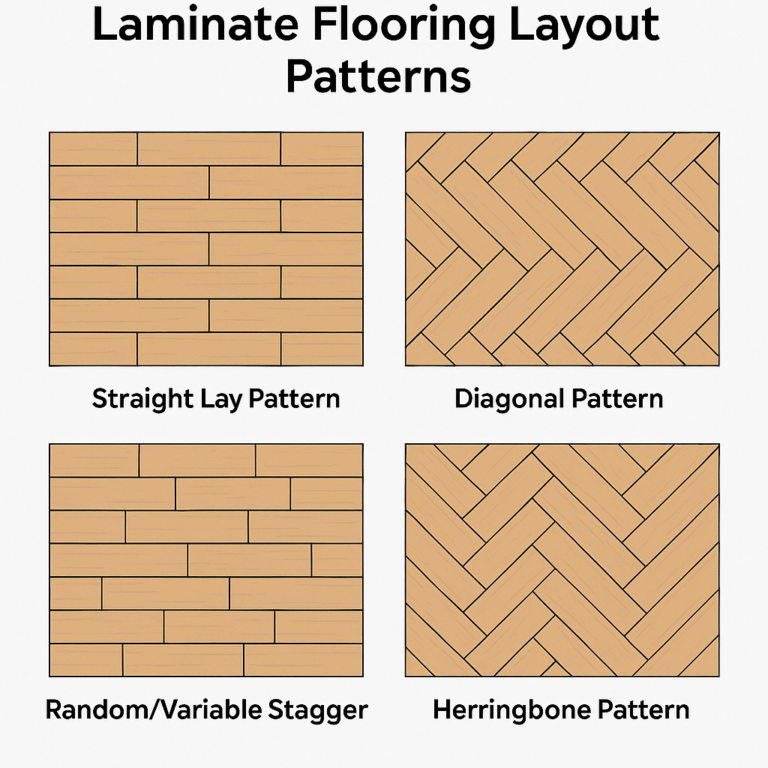
Here are some common patterns for laying laminate flooring:
Straight Lay Pattern (Most Common)
This is the easiest and most popular way.
Planks go parallel to the longest wall or towards the natural light. This gives a simple, classic look and works well for most rooms.
Diagonal Pattern
This offers a more stylish look.
Planks are placed at a 45-degree angle to the walls. This can make small rooms seem bigger and add interest to square spaces. You might need more cuts and material with this method.
Random/Variable Stagger
Planks are arranged in a staggered way, with different lengths in each row.
This mimics the natural look of hardwood and avoids repeat patterns.
Herringbone or Chevron (Advanced/Pro)
Some special laminate floors are made for herringbone or chevron patterns.
These designs are beautiful but need careful cuts and planning. Not all laminate brands have planks for these patterns.
Step 2: Prepare the Space
Take Off Baseboards and Old Flooring
First, take off any baseboards and old flooring to have a clean surface.
Use a pry bar to gently remove the baseboards — go slowly to avoid wall damage so you can use the trim again.
If changing carpet, cut it into smaller pieces with a utility knife and pull it up.
For vinyl or wood, follow the right steps to take them out.
Clean and Check the Subfloor
Sweep and vacuum well to clear dust and debris.
Look for cracks, dips, or high spots. Use a leveling compound to fill low areas and sand down high spots. A smooth subfloor is important for a long-lasting laminate floor.
Put Down Underlayment
Most laminate floors need an underlayment unless one is already attached.
Underlayment gives cushioning, cuts noise, and helps fix small subfloor issues.
Roll it out on the subfloor, making sure edges touch without overlapping. Tape the seams well.
✅ Tip: If putting it over concrete, think about adding a moisture barrier under the underlayment.
Step 3: Choose an Installation Method
Laminate flooring is easy for DIY projects, mainly using one simple method: Click-Lock (Floating Floor). Laminate usually doesn’t use glue or peel-and-stick ways.
Click-Lock (Floating Installation)
The Click-Lock system, also known as tongue-and-groove or interlocking, is the most popular and user-friendly way for installing laminate floors. Planks click together securely without nails or glue.
This method allows the floor to “float” over the subfloor, letting it expand and contract naturally with changes in temperature and humidity.
Key Benefits:
- No adhesives needed — easier cleanup and fewer materials.
- DIY-friendly — perfect for beginners.
- Versatile — works well over different subfloors like concrete and plywood.
Installation Tips:
- Always leave a 1/4-inch expansion gap around the room’s edge using spacers. This stops buckling as the floor changes size.
- Follow the manufacturer’s instructions for plank alignment and clicking techniques.
- Use a tapping block and pull bar to ensure tight seams without harming plank edges.
Step 4: Lay the First Row
Cut the Short Edge of the First Plank
Start by trimming the short edge of your first plank. This helps the plank fit nicely against the wall for a neater look. Use a utility knife for thin laminates or a circular saw or miter saw for thicker planks.
Place the First Plank 1/4 Inch from the Wall
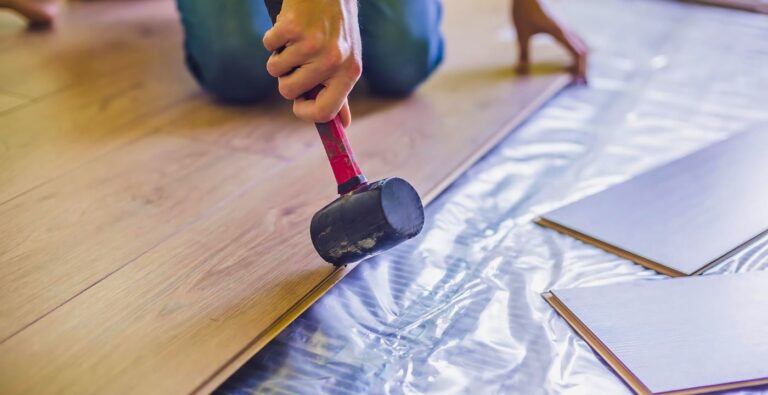
Set the first plank along the starting wall, leaving a 1/4-inch gap between the plank and the wall. This gap is important because laminate flooring expands and contracts with changes in temperature and humidity.
Use Spacers to Keep the Gap
Put spacers between the wall and flooring to maintain the gap as you lay the floor. Keep using these spacers all around the room.
Stagger End Joints for Strength and Look
When beginning the second row, cut the first plank to be at least 6 inches shorter than the first plank of the last row. This staggers the end joints, which makes the floor stronger and gives it a more natural look.
Tip: Don’t align joints across rows — this can weaken the floor and make it look less natural.
Step 5: Cutting Planks to Fit
Straight Cuts — Score and Snap
For straight cuts (like trimming the end of a plank):
Use a utility knife to score along your marked cut line.
Snap the plank along the score for a clean break (best for thinner laminates).
For thicker or tougher laminate, use a laminate cutter, circular saw, or miter saw for precise, clean cuts.
Irregular Cuts — Around Corners and Obstacles
When cutting around door frames, corners, or awkward shapes:
Use a jigsaw or oscillating multi-tool.
These tools allow precise, curved, or angled cuts that a standard saw can’t achieve.
Cutting Around Pipes
Measure the diameter of the pipe and add 1 inch for expansion.
Drill a hole in the plank to fit the pipe size.
Make a straight cut from the hole to the plank’s edge.
Once installed, seal around the pipe with a bead of silicone caulk to cover the gap and prevent moisture.
Tight Spaces — Under Door Jambs
Use a jamb saw (also called an undercut saw) to trim the bottom of the door frame.
This allows you to slide the laminate plank neatly underneath for a clean, professional look.
Pro Tip: Always wear safety goggles and work slowly when using power tools to avoid splintering the laminate or damaging surrounding materials.
| Cutting Task | Recommended Tool(s) | Technique |
|---|---|---|
| Straight cuts (length/width) | Utility knife (thin laminate) Laminate cutter or miter saw (standard) | Score and snap for thin laminate Use a saw for clean, straight cuts |
| Irregular cuts (corners, curves) | Jigsaw or oscillating multi-tool | Mark the shape, cut slowly following the line |
| Around pipes | Drill + Jigsaw or Hole saw | Drill a hole + cut a slit to the edge, leave ½” expansion gap |
| Tight spaces (door jambs) | Jamb saw (undercut saw) | Undercut the jamb to slide the plank underneath |
| Final fitting/trimming | Utility knife or laminate cutter | Trim small excess for a snug fit |
Step 6: Laying Subsequent Rows
Place Planks in Position
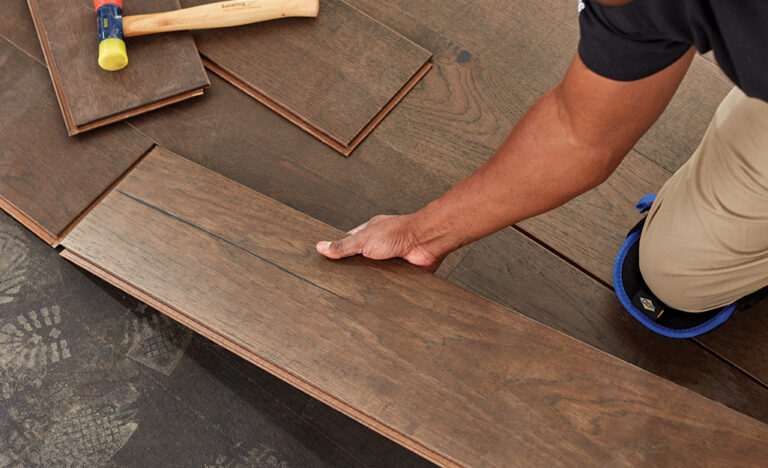
Start a new row by tilting the plank’s tongue into the previous row’s groove. Lower it softly until it clicks or fits well.
Use a Block and Soft Hammer
For a snug fit, use a tapping block and a non-marring hammer.
Set the tapping block against the plank’s edge.
Tap lightly to close gaps between planks.
Never use a regular hammer directly on the laminate—it can chip the edges.
Keep the Pattern Staggered
Stagger the end joints by at least 6 inches in every row for strength and a natural look.
Check Space for Expansion
Use spacers along walls to keep a 1/4-inch expansion gap during installation.
Step 7: Finishing the Installation
Install Transition Strips
Once you have placed all the planks, put transition strips at doorways and where the laminate meets other floors. These strips:
Make a smooth, safe change between floors.
Keep the edges of your laminate safe.
Follow the maker’s instructions for type and setup.
Transitioning to Other Flooring
Use the correct transition type:
T-molding for floors at the same height.
Reducer strips for moving to lower floors like vinyl.
Fix transition strips to the subfloor—never directly to the laminate—leaving a 1/4-inch expansion gap to stop buckling.
Reinstall Baseboards
Put the baseboards back, attaching them to the wall, not the floor. This lets the laminate expand and contract freely underneath.
Allow the Floor to Settle
Before putting furniture back or walking a lot on the floor:
Wait at least 48 hours so the laminate can adjust to the room’s temperature and humidity.
Common Mistakes to Avoid When Installing Laminate Flooring
Installing in Wet Areas
Laminate floors aren’t good for places with a lot of water, like full bathrooms or laundry rooms. Water can get into seams and cause swelling or warping.
Using Tools on Planks
Don’t hit the laminate directly with a hammer. Use a tapping block or pull bar to gently put planks in place without hurting the edges.
End Joints Alignment
Don’t line up the end joints of planks in nearby rows. This makes the floor weak and can cause gaps or uneven spots. Stagger the joints by at least 6 inches.
Expansion Gap
Leave a 1/4-inch expansion gap around the room’s edge. This prevents buckling from temperature and humidity changes.
Waiting Before Use
Let the laminate floor settle for 48 hours after it’s installed before walking on it or placing heavy furniture.
Tips for a Successful Laminate Flooring Installation
- Measure Carefully and Plan for Extra
Measure your room well and buy 10% more laminate flooring for cuts, errors, and future fixes. - Check Planks Before Laying
Look at each plank for flaws or damage before use. Put aside any damaged ones to keep the quality high. - Wear Knee Pads for Comfort
Use knee pads to protect your knees, especially during long installs. This helps you work better. - Work Slowly and Carefully
Go slowly with each step, from starting the first row to cutting planks. Rushing can cause bad fits and mistakes. - Keep the Right Expansion Gap
Leave a 1/4-inch expansion gap around the edges to stop buckling as the laminate changes.
DIY vs. Professional Laminate Flooring Installation
Many people pick laminate flooring because it’s easy to install by yourself. Whether you do it yourself or get a pro depends on your skills, tools, and how hard the job is.
DIY Installation
✅ Pros:
- Save money on labor (usually $2 to $5 per sq ft).
- Work at your own speed.
- Good for small, simple areas.
❌ Cons:
- Needs basic tools (spacers, tapping block, saws).
- Wrong expansion gaps can cause issues.
- Takes time, especially in big or odd-shaped areas.
Professional Installation
✅ Pros:
- Quick and accurate installation.
- Experts handle floor prep and tricky cuts.
- Often comes with a warranty.
❌ Cons:
- Costs more — typically adds $2 to $5 per sq ft for labor.
Usually, laminate flooring installation (materials + labor) costs between $4 and $12 per square foot based on style and difficulty. For more details, see our Laminate Flooring Cost Guide.
| Installation Method | Average Cost per Sq Ft | Pros | Cons |
|---|---|---|---|
| DIY Installation | $1.50 – $4 (materials only) | Save on labor Flexible schedule Good for small areas | Time-consuming Needs tools & skills Mistakes can be costly |
| Professional Installation | $4 – $12 (materials + labor) | Fast & precise Warranty often included Handles complex cuts & transitions | Higher upfront cost |
Do You Need Professional Help With Your Laminate Flooring Installation Project?
Now that you’ve learned how to install laminate flooring, you’re ready to make a stylish, strong floor. If you’d prefer not to do the hard work, our expert team can help.
We manage everything — from getting the subfloor ready to aligning planks perfectly — so you can relax and enjoy great, lasting results. We’ll also help you pick the right laminate style and underlayment to fit your space and budget.
Contact us today to schedule your free in-home consultation and see if we serve your area.